How to Track Injection Site Rotation
It can be difficult to remember exactly which injection sites you’ve used over time. A rotation record answers that from your own history — and it takes one tap per entry to keep.
Site rotation is standard practice for anything injected, and it is one of the few parts of a routine where a log genuinely earns its keep. Not because it decides anything for you — it does not — but because it replaces a guess with a count.
This guide covers how to record sites so the history is actually countable, how to read the pattern once you have a couple of months of it, and where the honest limits of that record are. It assumes you already have a logging habit; if you do not, start with how to track peptide doses and come back.
What this guide is not. This is a record-keeping guide. It does not tell you which site to use, how often to use it, or how to rotate — those are decisions for you and a qualified healthcare professional. Everything here is about capturing and reading what you have already done.
Why memory is the wrong tool for this
Ask someone which sites they use and you will usually get an even-sounding answer: "I move around, left and right, stomach and thighs." Ask their log and the answer is frequently lopsided — one convenient site doing far more work than the rest, and one or two sites that quietly dropped out of the rotation months ago and were never missed.
This is not carelessness. It is how habits work. You reach for whatever is easiest in the moment, and each individual choice feels like a one-off. Fifty one-offs later there is a pattern that nobody decided on. Memory smooths that out because it recalls the intention, not the distribution — which is exactly why the intention is not worth recording and the distribution is.
Use a fixed set of site labels
The single decision that determines whether your rotation record is useful is whether the site is a fixed label you pick or free text you type. Everything else is detail.
Free text feels flexible and destroys the record. Over three months you will write "thigh", "L thigh", "left thigh", "lft thigh" and "thigh (left)", and those are five different values as far as any count is concerned. You cannot total them, filter them, or compare them. The history is still there in a sense — you just can't ask it anything.
Left and right are two different sites
"Thigh" is not a site. "Left thigh" and "right thigh" are two sites, and collapsing them is the most common way a rotation record ends up flattering. Someone alternating strictly between left and right thigh and someone using only the right thigh produce an identical history if the label is just "thigh" — and those are very different patterns.
A practical set covers each region with a left and a right variant, plus anything that genuinely has no side. That works out to something like stomach, thigh, glute, shoulder and arm each split left and right, plus the back on its own — eleven labels, which is small enough to pick from at a glance and specific enough to count.
Keep the list short and stop editing it
Resist adding finer distinctions later. If you start with eleven sites and then split each into upper and lower after two months, your first two months become incomparable with everything that follows. A slightly coarser list you have kept consistently is worth far more than a precise one you changed halfway through.
What a rotation record needs to capture
Three fields, and you almost certainly already have two of them:
- The site, from your fixed list.
- The date, which you are recording anyway.
- An optional note, for the occasional entry where something is worth remembering about that site — soreness, a mark, anything you would want to mention to a clinician later.
That is the whole schema. Rotation tracking does not need its own system, its own app, or a separate chart. It needs one extra field on the entry you were already making, which is why it costs a tap rather than a habit.
Reading your own pattern
A rotation record does nothing for you in week one. Give it six to eight weeks and it starts answering questions. There are two worth asking.
Which sites are carrying too much
Count entries per site and sort them. With eleven sites and even use, no single site should be far ahead of the others. What people usually find instead is one site at three or four times the share of the rest — nearly always the one that is easiest to reach or least uncomfortable.
This is the number that surprises people, and it is genuinely useful information precisely because it contradicts the intention. Take it to whoever advises you on your routine. It is a fact about your history, and it is the sort of fact that is very hard to produce from memory.
Which sites have silently dropped out
The mirror image is more easily missed: sites that have not appeared in your log for weeks or months. Nobody notices a site they have stopped using, because nothing prompts you to. Sorting by the date each site was last used surfaces it immediately — and "not since April" is a much sharper prompt to have a conversation than "I think I've been favouring my right side."
Logging the site without slowing yourself down
The whole system fails if recording the site is annoying, because you will start skipping it on the busy days — and the busy days are not randomly distributed, so the gaps will not be random either. A record with a systematic hole in it is worse than no record, because you will still trust it.
Two things keep it fast. Make the site a one-tap choice from a visible list, never something you type. And log it at the moment, in the same action as the rest of the entry, rather than intending to add it later. An entry saved without a site is almost never corrected afterwards.
If you do miss it, leave the field empty rather than guessing. A blank is honest and you can see it. A guessed site is indistinguishable from a real one forever after, and it quietly corrupts every count you will ever run.
What the record can and cannot tell you
Being clear about this is what keeps the record trustworthy.
It can tell you how many entries each site has, what share of the total that is, when each site was last used, how the distribution has changed over time, and which sites you have never used at all. All of that is arithmetic on things you actually did.
It cannot tell you which site to use next, how long to leave a site, whether your rotation is adequate, or what any mark or soreness means. Those are clinical judgements. A log that offered them would be guessing, and a confident guess is worse than silence.
The right shape for this is a record you bring to someone qualified, not a system that advises you. "Here is what I have actually been doing over the last three months" is a genuinely useful thing to put in front of a clinician, and it is the thing almost nobody arrives with.
Keeping the record honest over months
Three habits keep a rotation history worth reading a year in.
Do not backfill sites from memory. Reconstructing last week's sites produces a record that looks complete and is fiction. Site is the field memory is worst at, because there was never anything distinctive to remember.
Do not tidy the history. The temptation to even out a lopsided-looking log is real and it is the one thing that makes the record useless. Its entire value is that it disagrees with your impression.
Check it on a schedule, not on a feeling. Once a month, look at the counts and the last-used dates. Five minutes. If you only look when you suspect something, you will only ever confirm what you already suspected.
Tracking rotation in Piri
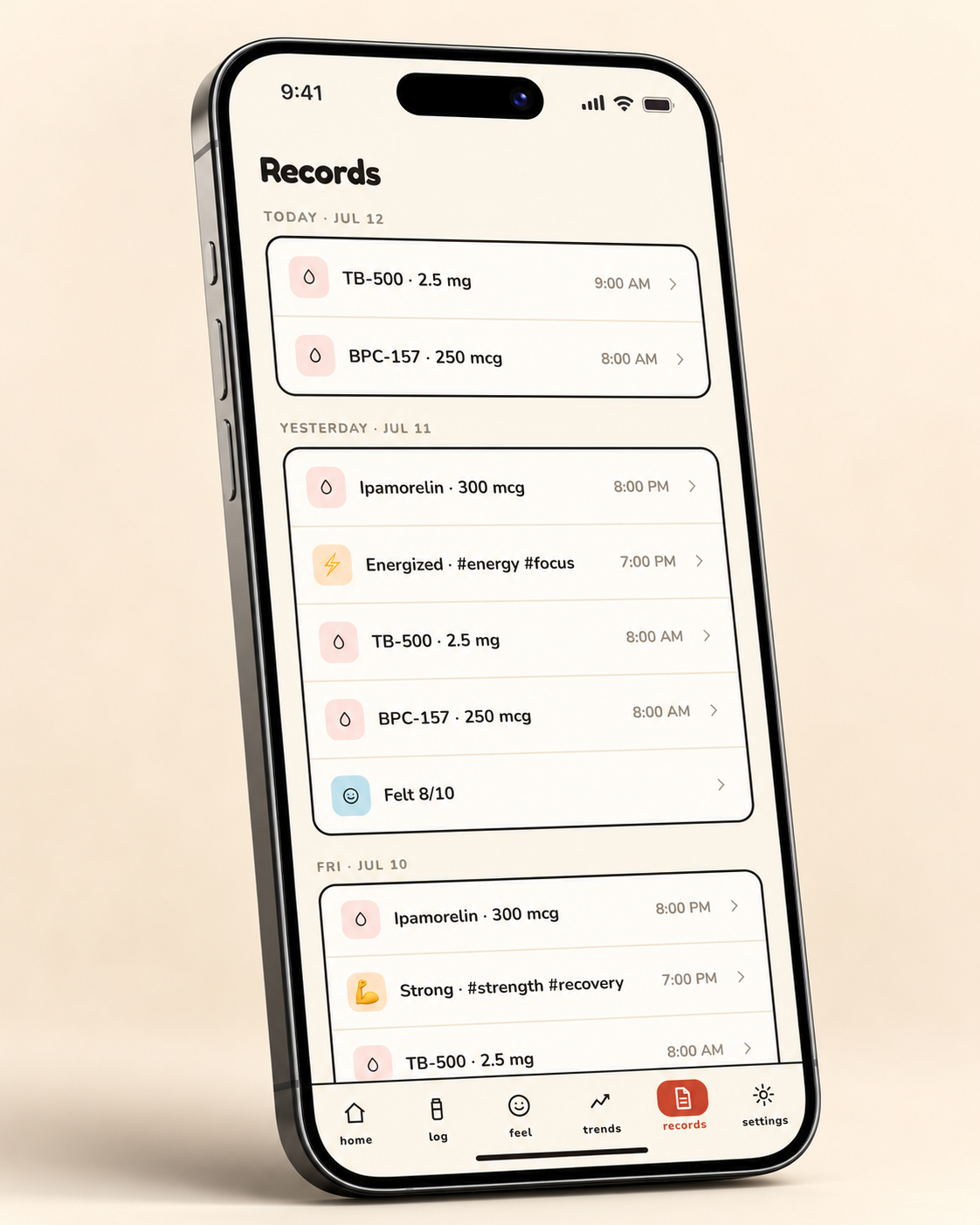
Piri stores the injection site as its own field on every entry, chosen from a fixed list of eleven sites — stomach, thigh, glute, shoulder and arm each with separate left and right variants, plus the back. It is one tap while you are logging, and because it is a real field rather than text in a note, the history stays countable and searchable.
The site is optional, so nothing forces you to record it and a skipped entry stays honestly blank. Everything is stored on your device, and when you want to show someone, the CSV and PDF exports include the full history.
See the Support & FAQ for how logging and exports work, or how to track peptide doses for the wider logging system this fits into.

A rotation history you can actually count
Eleven fixed sites with left and right variants, recorded in one tap and stored on your device. No account, no cloud, no subscription.

Piri is a personal journaling and organization tool. It is not medical advice and does not recommend, prescribe, endorse or supply any substance or dose. Always consult a qualified healthcare professional before making healthcare decisions.