How to Track Peptide Doses: A Simple Logging Guide
A peptide log is only worth keeping if you can still read it six months from now. Here is a simple system for recording what you did, when you did it and where — without turning your routine into paperwork.
Most people start tracking peptides in whatever is closest to hand: a note on their phone, a spreadsheet, a photo of a paper calendar. That works for about three weeks. Then the notes app has forty entries in no particular order, the spreadsheet lives on a laptop you do not carry, and nobody can remember whether Thursday actually happened.
The fix is not more discipline. It is a smaller, more consistent record — a handful of fields, captured at the moment, in one place. This guide covers what to record, how to keep schedules and cycles straight, why injection-site history is worth the two seconds it costs, and how to end up with a history you can actually review.
What this guide is not. This is an organization and record-keeping guide. It does not recommend any compound, any amount, any schedule or any course of treatment, and it is not medical advice. Those decisions belong with a qualified healthcare professional.
What a peptide log actually needs to record
A useful entry answers four questions: what, how much, when and where. Almost everything else is optional. If you capture only those four consistently, you have a record that holds up — and one you can hand to a clinician without translating it first.
The fields worth capturing
- Name. Whatever you call it, call it the same thing every single time. Inconsistent naming is the number one reason logs stop being searchable.
- Amount. Record the number and the unit exactly as you measured it. Your log stores what you did; it should never be doing arithmetic on your behalf.
- Date and time. Time matters more than people expect. A routine that drifts from morning to late evening is a pattern you will only spot if the time is in the record.
- Injection site. One tap, and it is the field that pays off most over months. More on this below.
- Notes. Optional and usually empty. When something is worth writing down, you will know.
Resist adding more fields than that. Every extra field is a small tax on every future entry, and a log you skip is worse than a log with four columns.
Log in the moment, not at the end of the week
Backfilling is where records go wrong. Reconstructing Tuesday on Sunday produces a log that looks complete and is quietly fiction — the time is a guess, the site is a guess, and the entry you forgot entirely is simply gone.

Log at the moment of the event, before you put anything away. If your system takes more than about fifteen seconds, it will lose to the moment eventually, so optimize for speed over completeness: a fast entry with four fields beats a thorough entry you never make.
When you do miss one, mark it as missed rather than deleting the expectation. A gap you can see is information. A gap you erased just makes your adherence look better than it was.
Organize by routine, not by entry
A flat list of entries tells you what happened. It does not tell you what was supposed to happen, which means it cannot tell you what you missed. That is the difference between a notebook and a tracker.
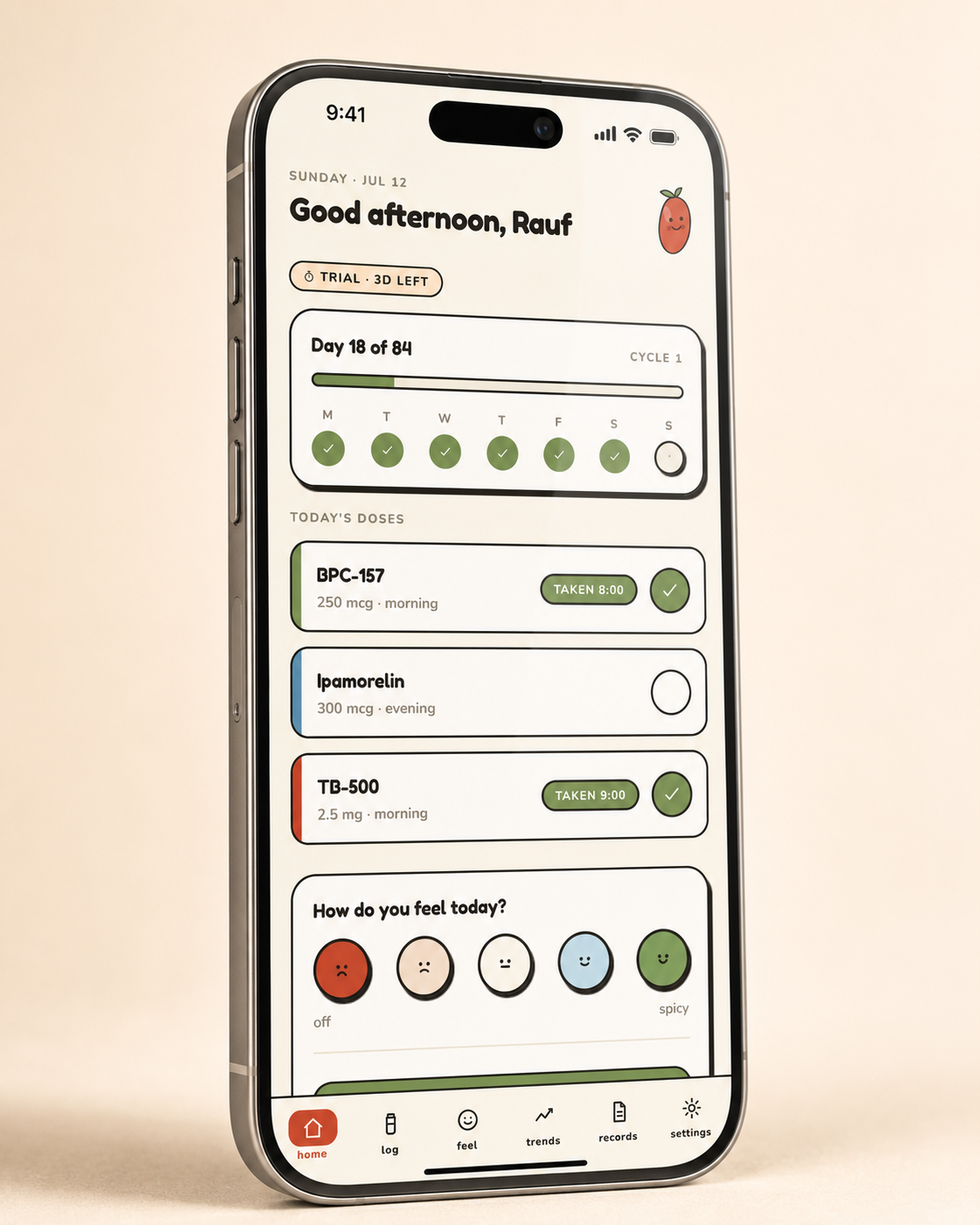
Define the routine once — which item, which days, what time — and let each day's entries be checked off against it. Now your log has an expectation to compare against, and “did I miss anything this week?” becomes a glance instead of an audit.
Cycle days versus calendar dates
If your routine runs in cycles, track the cycle day alongside the calendar date. “Cycle 2 · Day 18” is the number you actually think in; 3 September is the number your phone thinks in. Recording both means you never have to count forward from a start date on your fingers, and when you look back at a note from months ago you immediately know where in the cycle you were.
Note the start and end of every cycle explicitly, including breaks. A break with a recorded start and end is part of the history. A break you simply stopped logging through is a hole.
Keep an injection-site record
Site rotation is standard practice for anything injected, and it is one of the few things a log can genuinely help with — not by telling you what to do next, but by showing you what you have actually been doing. It can be difficult to remember exactly which injection sites you’ve used over time.
The one rule that matters here: use a fixed set of site labels you tap, and treat left and right as separate sites. Free text you type cannot be counted later.
This is worth doing properly, so it has its own guide: how to track injection site rotation covers the labels, how to read your own pattern, and the limits of what the record can tell you.
Use reminders as a safety net
A reminder should do one job: catch the day you would otherwise forget. Set it for the time you realistically act, not the time you aspire to. A 6 a.m. alert you swipe away every morning trains you to ignore the app, which is the opposite of what you wanted.
One reminder per scheduled day is usually plenty. If you find yourself needing three, the problem is the schedule, not the reminder. And make sure notifications are actually enabled at the system level — a silently disabled reminder is indistinguishable from a reminder that never fired.
Write notes your future self can use
Most entries need no note. The ones that do are usually deviations and observations: a changed time, a missed day and why, a new batch, how you slept, how the site felt afterwards.
Two rules make notes worth re-reading. Keep them short — one line beats a paragraph you will skim past. And record observations rather than conclusions: “woke twice, groggy until 10” is a fact you can compare against other weeks. “Bad reaction” is a verdict you will not be able to re-examine later.
A quick daily check-in — a one-tap rating plus an optional line — is worth more than long entries written occasionally. Any single day is noise. The week is the signal, and you only get a week's worth of signal by capturing the days.
Turn your history into something you review
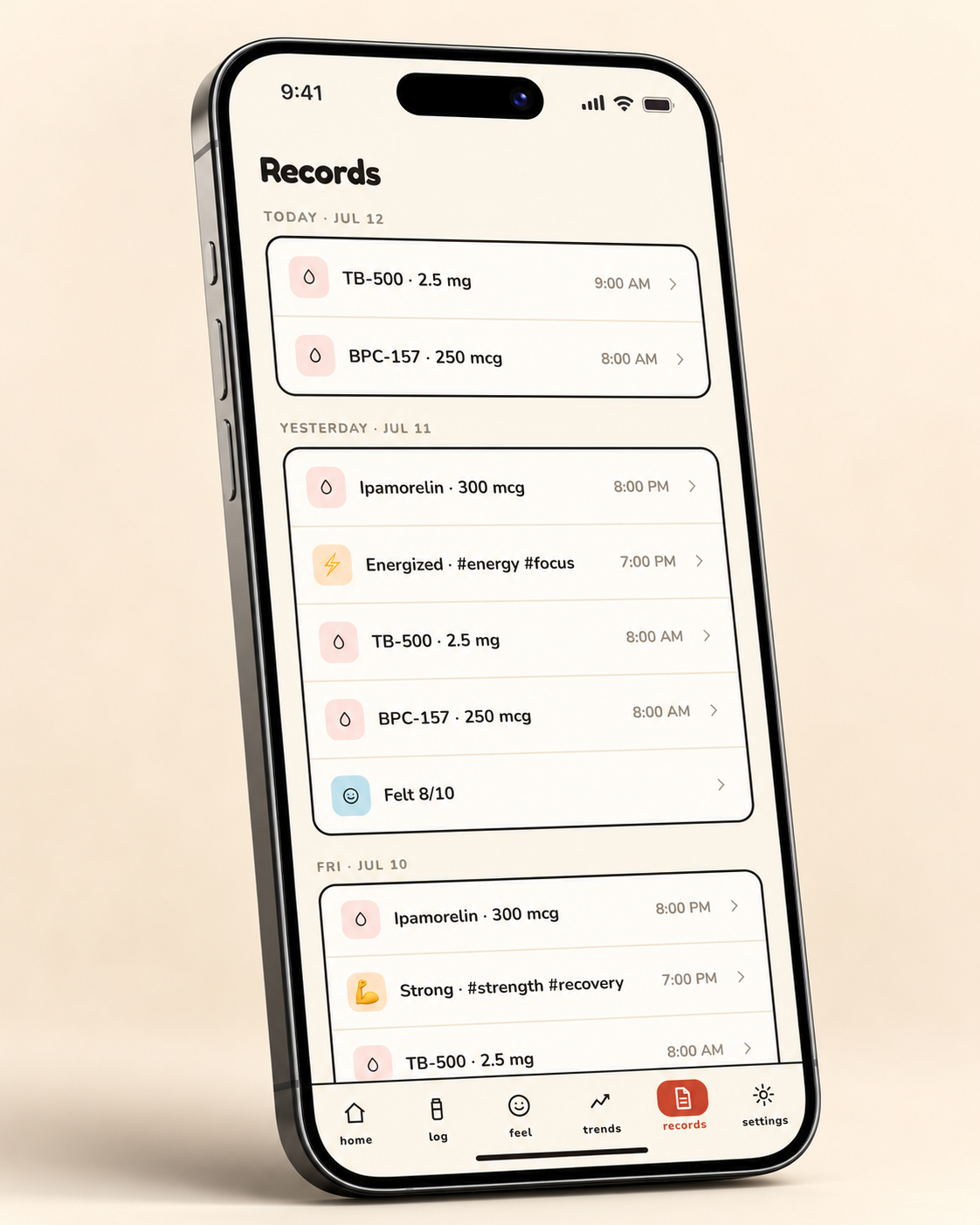
Data you never look at is just storage. Build in one small review so the log earns its keep: once a week, check whether the scheduled days actually happened, whether the times are drifting, and whether anything in this week's notes repeats from last week. Five minutes is enough.
Reviewing, recovering from missed days, exports and backups are the maintenance half of tracking, and they have a guide of their own: how to keep a peptide log.
Five habits that make a log useless
- Inconsistent naming. Three spellings of the same thing is three separate items as far as search is concerned.
- Backfilling from memory. Produces a tidy record of a week that did not happen that way.
- Deleting missed days. Removes the one signal that would have told you the schedule is not working.
- Free-text sites. Unfilterable, uncountable, and slower to enter than tapping a fixed label.
- Too many fields. Every optional field you add makes the next entry a little less likely to get made at all.
Doing all of this in Piri
Piri is built around exactly this system. You define a protocol with its schedule and cycle length, and the home screen shows your day in the cycle with today's entries as a checklist. Logging takes one screen: item, amount, site from a fixed list, time, and an optional note. Injection sites are stored as their own field with left and right variants, so the history is countable rather than a pile of text. Reminders fire on scheduled days, the daily check-in takes one tap, and records are searchable. Exports go out as CSV or PDF, and backups write a file you keep.
All of it stays on your phone — no account, no cloud, no sync. See the Support & FAQ for how each piece works, or the privacy policy for exactly what is and is not stored.

A log that stays readable
Doses, schedules, injection sites, cycles, reminders and notes — organized, searchable and stored on your device. Free for seven days, then one purchase. No subscription.

Piri is a personal journaling and organization tool. It is not medical advice and does not recommend, prescribe, endorse or supply any substance or dose. Always consult a qualified healthcare professional before making healthcare decisions.